
Global Registration Identifier
for Donors (GRID)
What is GRID?
WMDA has developed a unique global donor identifier to ensure secure, reliable and unambiguous assignment of donors across the world. This is called the Global Registration Identifier for Donors (GRID). This has been done to facilitate communication and to prevent errors in identification of donors on a global scale and has to be adhered to by all WMDA member registries.
The purpose of the GRID is to:
- Reduce the risk of misidentification of hematopoietic stem cell (HSC) donors caused due to different methods of identification systems followed by various registries;
- Provide a standard eye-readable format for the donor identifier;
- Provide a standard machine-readable format for the donor identifier that can be used by computer systems;
- Provide a check sum for transcription control;
- Provide consistent documentation;
- Improve traceability of donors.
How GRID system works
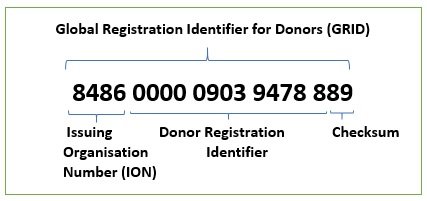
The GRID is of a fixed length of 19 characters, composed of three specified elements. Please refer below diagram:
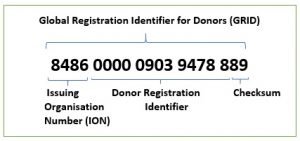
GRID has 19 digits as shown in above example. The first four-digit number represents the issuing organization number (ION), which is allocated by International Council for Commonality in Blood Bank Automation (ICCBBA) in collaboration with the WMDA. ION is followed by a middle part that provides space for 13 alphanumeric characters for unique donor number and a 2-digit checksum in the end. ION for DATRI is 8486, and the first five digits of the middle part are denoted as “0000 0” to provide for future registry expansion. The next 8 digits (10th to 17th digit) denote the existing Donor ID. The last 2 digits (18th and 19th digits) form the checksum.
Regarding privacy, the coding elements ensure donor anonymity as the ION is the only part publicly available and traceable.
GRID Implementation
All organisations involved in the process of recruiting, facilitating and providing haematopoietic stem cells from volunteer donors (like DATRI) have implemented or are in the process of implementing GRID. DATRI began the GRID implementation process in January 2019, and for the last 1.5years we have maintained both Donor ID as well as GRID in our forms, to allow for ease of transition of our clients (TC/AC/CC). Now as per WMDA directive, we have begun the transition to retaining ONLY GRID in all our forms. From 15th December 2020 all our collection/ donation related forms will herewith carry only GRID instead of Donor ID and GRID.
Reference Articles:
https://wmda.info/professionals/optimising-search-match-connect/why-global-identifier/
FAQs on GRID
How does GRID implementation impact me as a Transplant/ Collection Center?
In all collection/ donation related forms Donor ID will be replaced with GRID. This will mean that in the space/ box where “Donor ID” used to be mentioned, it will instead show “GRID”. For all communication purposes GRID will have to be mentioned in place of Donor ID. There is no other impact on collection/ donation process as such
What if I have the Donor ID and do not have GRID?
DATRI will be able to trace the donor using the Donor ID for such specific instances. However, we would recommend that you start maintaining the GRID in your records as well.
Will a donor’s number also change? How can he / she get his / her new GRID?
The existing donor ID will be integrated into the GRID. For eg., let us take the GRID given above – 8486 0000 0903 9478 889. As you can see, there are 19 digits in it. In this, the initial 4 digits denote DATRI’s ION number (8486), the next 13 digits highlighted here form the unique donor number (of which the first 5 digits are zeros to provide for future expansion of the registry and the next 8 are the existing unique donor number issued by DATRI) and the digit 89 given at the end is the checksum. So, a donor with Donor ID 90394788 would now be identified by his / her GRID id 8486-0000-0903-9478-889.
Donor can write to DATRI at info@datri.org with his / her donor id and we shall share the GRID ID.
What is DATRI’s GRID?
The Issuing Organisation Number (ION) for DATRI is 8486. This means that any GRID beginning with 8486 indicates a Donor registered with DATRI.
As a TC / AC doctor / coordinator are we expected to memorise the GRID?
No. Like Donor ID, this is a registration identifier and could be traced/ used similarly. We request you to quote the same while corresponding regarding any donor.
What is eye-readable format?
Eye-Readable format is a number or code that can be read by human eye without aid of a computer or other tools, like a printed standard number. Space has been provided between every 4 digits of the GRID to make it easy for us to read (eye-readable).
Would this change in the Search Report also?
Yes. GRID number will be part of all Search/ Collection related forms wherever donor registration needs to be mentioned.
Would donor clearance / donor history form / collection form etc all forms have the GRID ID or would earlier ID be also mentioned?
Only GRID will be mentioned in all such forms from 15th Dec 2020. Currently these forms have provision for mentioning both Donor ID and GRID.
Would a specific space be defined for the GRID ID?
Yes, GRID will replace Donor ID (in the space provided for entering Donor ID) in all forms.
If we have an old search report, do we need to run the search again?
If we receive a Search request mentioning Donor ID, we have to re-run the search in our software. The new Search Report will carry the GRID number. This will also help avoid confusion by ensuring uniformity in all donation related documents.
If we want a DLI, how would the donor be traced?
It is possible for DATRI to identify the GRID number using Donor ID for such specific instances. Donor can be traced in this manner.
Will this change impact the collection / donation dates?
No, collection/ donation date will NOT be affected due to this
Are there any cost implication for this implementation?
There is no cost implication for collection/ transplant centers.
Are all registries making this change?
Yes, all WMDA member registries are making this change as it is a global guideline put forth by WMDA


